

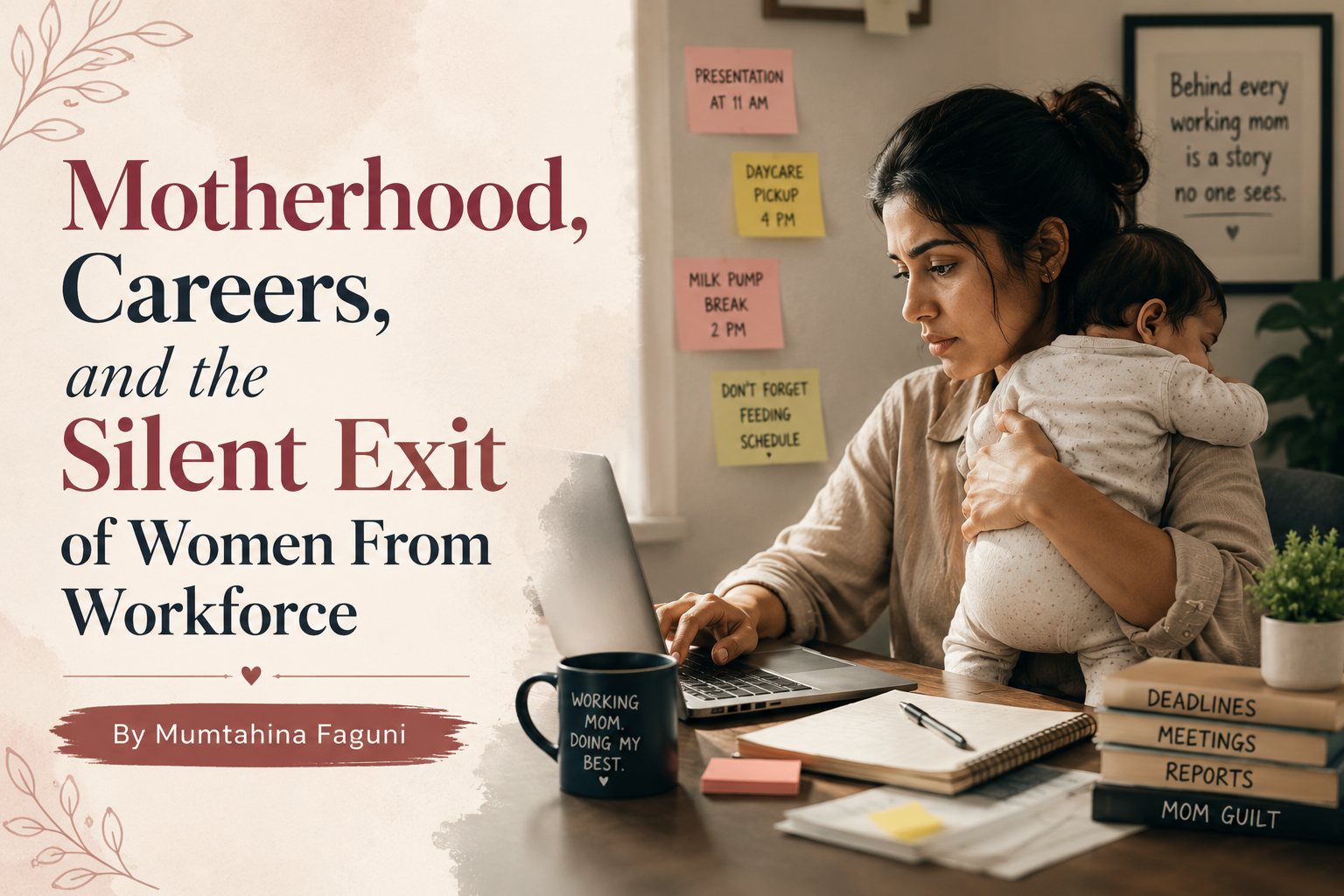
Like every Mother’s Day, this year too, my social feeds were flooded with sweet wishes, emotional campaigns, and corporate gestures celebrating mothers.
But honestly? Most of these feel performative to me now.
Many companies are busy posting appreciation posts and arranging celebrations while ignoring the real-life struggles working mothers face every single day. Sometimes it feels less about supporting mothers and more about highlighting corporate brand names.
And I have honestly become tired of seeing this cycle repeat every year.
Because in Bangladesh, being a working woman and a mother at the same time is incredibly difficult. It drains women mentally, physically, emotionally, and professionally. There are so many huge problems standing right in front of us, yet we barely address them seriously.
So this year, instead of writing another emotional Mother’s Day appreciation post, I thought:
Why not discuss the real scenarios?
The things that I and countless women around me experience every day.
And just to clarify; these are not only my personal experiences, nor is this written to target or hurt anyone. These thoughts, stories, fears, and frustrations are collected from conversations with many women I regularly meet in different stages of life and career.
I’ve already written a shorter version on LinkedIn, which you can read here: LinkedIn version of the article.
But here, on my own site, I wanted to be more direct. More honest. Maybe even a little brutal.
Hopefully, this gives a clearer picture of what many working mothers in Bangladesh silently go through every day. Happy reading.
Mother’s Day Always Felt Different To Me
Mother’s Day has always been special to me.
As a child, I used to make handmade cards and write poems for my mother. Being raised by a working mom made the occasion even more meaningful. I still get mesmerized thinking about how she handled four children, household responsibilities, and a full-time job as a gynecologist.
To us, she was a superhero.
But growing up and entering professional life gave me a reality check:
Being a mother and a working woman at the same time is not easy at all.
And in Bangladesh’s private job sector, the struggle becomes even harder.
The Workplace Reality Women Rarely Talk About
Gladly in government organizations, you will get 6 months of paid maternity leave. But it doesn’t reflect the actual scenario of all of us. In many private companies, maternity leave is still limited to only 3 or 4 months. Some companies do not even provide a full salary during leave. Some create conditions like:
“You will only receive the unpaid amount if you rejoin and stay for another 6 months.”
And then comes the silent workplace discrimination.
The moment a woman announces pregnancy, the treatment often changes subtly.
Sometimes directly. Sometimes indirectly.
Promotions get delayed.
Important responsibilities disappear.
Performance evaluations suddenly become “complicated.”
I remember hearing a senior employee from a multinational company once describe motherhood and corporate life together as “a permanent negotiation with guilt.”
That line stayed with me.
Because sometimes the happiest personal news becomes one of the scariest professional announcements.
A woman immediately starts calculating:
Will I lose the promotion?
Will they stop trusting me with leadership?
Will I slowly become “less reliable” in everyone’s eyes?
Many women never say these fears out loud.
But they exist.
The Hardest Part Starts After Becoming a Mother
I understood this reality even more deeply after becoming a mother myself. People think the challenge ends after delivering a healthy baby.
Actually, that is when the hardest phase begins.
When you return to work after 3 or 4 months, you do not return as the same employee anymore. You return while carrying a 100% dependent human being emotionally and physically every single hour of the day.
🔴 Extra office hours disappear.
🔴 After-work hangouts become impossible.
🔴 You cannot stay late because someone is waiting for you at home.
🔴 You cannot arrive too early because your morning already started with feeding, cleaning, calming, preparing, and emotionally detaching yourself from your baby before leaving for the office.
And despite doing double the emotional labor, mothers are still expected to perform at the same pace and availability as before.
Many mothers miss their baby’s first words or first steps while trying to maintain their careers. Yet they continue, because for many women, work is not only about financial independence. It is also about identity, dreams, passion, and stability.
Sometimes the happiest personal news becomes one of the scariest professional announcements.
A woman starts calculating everything immediately:
Will I lose the promotion?
Will they stop trusting me with responsibilities?
Will I slowly become “less reliable” in everyone’s eyes?
Many women never say these fears out loud. But they exist in almost every workplace conversation around pregnancy.
“Just Put The Baby In Daycare” Is Not A Simple Solution
Whenever this discussion happens, people immediately suggest the following:
“Hire a nanny.”
“Put the baby in daycare.”
As if safe childcare is easily accessible.
In Bangladesh, trusted daycare facilities are still very limited, expensive, and often far away from both home and office locations. And every few weeks, we see horrifying stories online about negligence or abuse in childcare environments.
So mothers go to work carrying another invisible burden:
uncertainty.
You spend the entire workday wondering:
Did my baby eat properly?
Is someone holding the baby gently?
Is my child crying right now?
That anxiety never fully leaves.
And the saddest part is: This struggle is still considered the “privileged” version. Because many women do not even have basic support systems at home to continue working after motherhood.
As a result, countless talented women quietly leave the workforce after motherhood.
Not because they lack skills. Not because they lack ambition. But because the system was never designed with mothers in mind.
The System Was Never Built With Mothers In Mind
We often compare Bangladesh with countries like the US, Canada, or Australia.
But in many places, mothers receive much longer paid maternity leave, better workplace flexibility, and accessible childcare support systems.
Meanwhile, here, even girls’ restrooms or private nursing spaces are considered a luxury in many offices.
So how can we resolve this situation and bring back women in the workforce after pregnancy?
🟢 A daycare in the workplace could completely change life for working mothers.
🟢 Flexible nursing spaces could help.
🟢 Official partnerships with trusted daycare centers could help.
🟢 Remote flexibility during early motherhood could help.
But most companies are not willing to carry these costs.
Why?
Because in profit-loss calculations, motherhood is still often treated as “loss.”
And that mindset starts very early.
At the beginning of my career, I repeatedly heard things like the following:
“Paying 4 months’ salary while someone is not working is already generous.”
“Pregnancy leave creates workflow loss.”
“Projects get delayed because of maternity leave.”
Later, during a Google Developers community meetup, I heard a senior employee from an MNC explain something even more disturbing:
Many management teams internally see pregnancy leave as almost like an inconvenient vacation period.
And honestly, that explanation exposed a bigger problem:
management inefficiency.
Because employees disappear temporarily all the time.
People get sick for months.
People resign suddenly.
People take long vacations.
Some employees cumulatively remain absent for months every year.
Companies adapt to all of these situations.
But when the absence happens because a woman is becoming a mother, suddenly the entire workflow becomes “impossible”?
That is not a woman’s problem.
That is poor organizational planning.
A properly managed team should be able to handle temporary transitions smoothly. If women receive proper support before leaving, they can hand over responsibilities properly and rejoin the team’s current progress instead of restarting from zero.
But instead of improving systems, many workplaces quietly push women out after motherhood.
And then on LinkedIn, the same companies post:
“Happy Mother’s Day to all the amazing moms.”
That contradiction is becoming harder for me to ignore.
And maybe that is the saddest part.
The system was built without properly considering women’s realities, especially mothers’. Then we act surprised when talented women slowly disappear from the workforce after motherhood.
This Mother’s Day, I Don’t Have A Perfect Conclusion
People often ask:
“So what is the solution?”
Honestly, I do not fully know.
I am writing this after putting my baby to sleep, knowing tomorrow morning I will again leave for work, carrying uncertainty with me.
So this Mother’s Day, I am not writing a celebratory post filled with inspiration.
I am simply hoping we start having more honest conversations about what working mothers are actually going through.
Because right now, for many women, survival itself already feels like an achievement.
This Mother’s Day, I hope we stop celebrating mothers only with flowers and greetings. I hope we start building systems that truly support them. Because empowering mothers is not charity. It is progress.
Leave a Reply